
3,000 claims filed,
structured and verified.
3,000+
claims filed structured in a single large-scale proceeding
Weeks
not months from unstructured intake to structured file
Zero
duplicate entries structured data directly into Advocat
Product
Puttinger Vogl uses UNOY as UNOY Legal Engine.
UNOY Legal Engine is the product suite for controlled legal workflows with playbooks, approvals and audit trail. At Puttinger Vogl deployed as Intelligent Intake in the Co-Build model: client inquiries are structured, classified and handed over to Advocat.
In use
- Intelligent Intake (client inquiries)
- Intake classification by AI
- Structured case data
- Advocat handover
- Attorney approval before processing
Model & Key Data
- Co-Build · built together
- Advocat integration
- Mid-size law firm
Background
Who is Puttinger.Vogl?
Puttinger.Vogl Rechtsanwälte is a law firm specialising in insolvency law, based in Upper Austria. The firm acts as insolvency administrator; handling insolvency proceedings is part of daily practice. That means: managing the insolvency estate, reviewing and registering creditor claims, negotiating with parties involved and preparing the legal groundwork for realisation.
A mass proceeding is complex, time-critical and demands absolute accuracy. Especially in larger insolvency cases: every claim must be reviewed formally and substantively. Every filing must be documented, categorised and prepared for further legal processing. In a large-scale proceeding that can mean thousands of cases, running in parallel, under constant time pressure, with deadlines that do not wait.
The Problem
What was difficult before.
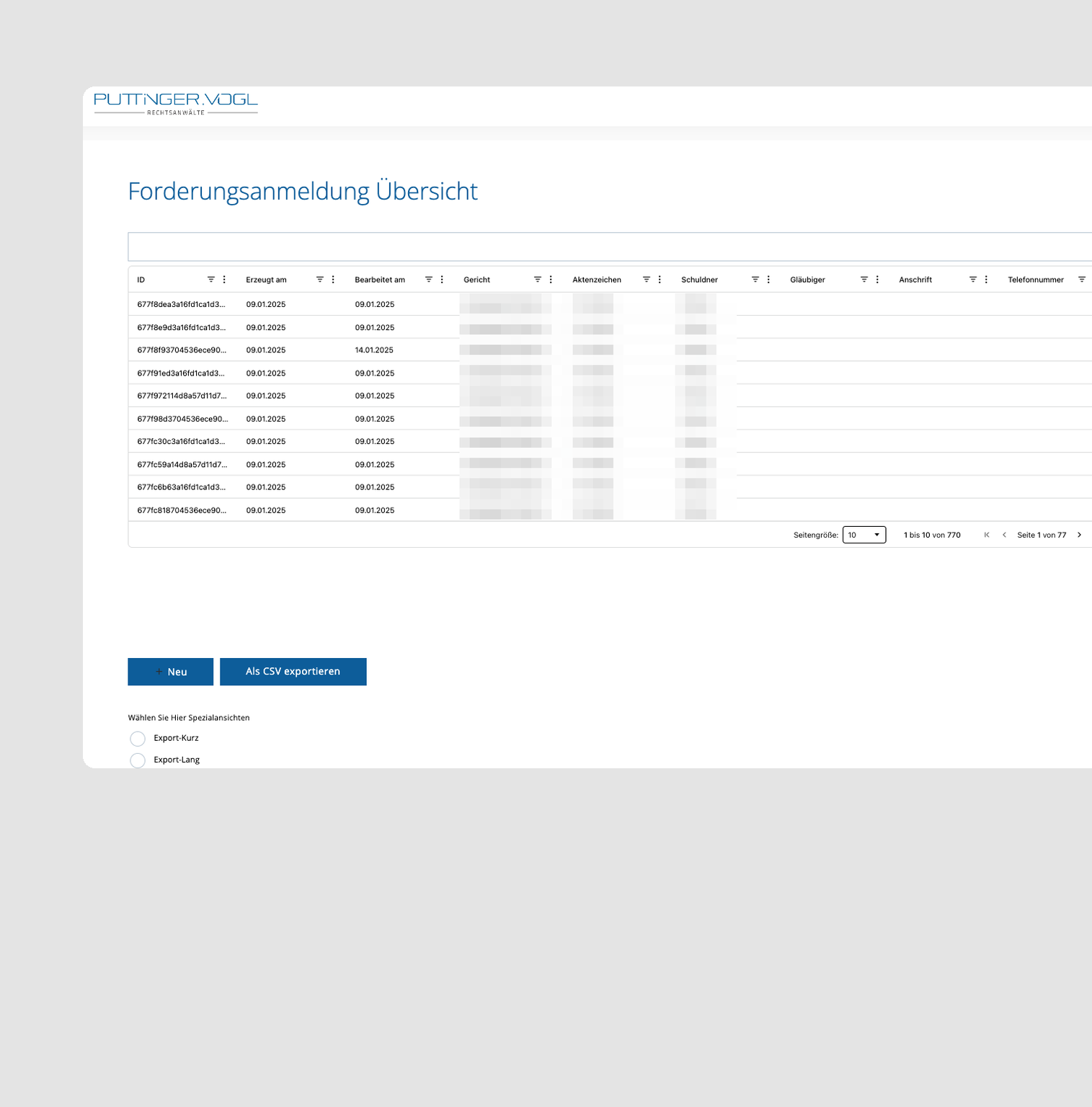
One specific large-scale proceeding: more than 3,000 claim filings in a single insolvency case. The filings arrived through every conceivable channel: emails, PDF invoices, free-text messages, handwritten notes, bank statements, delivery confirmations. Every source, every format, no standards.
The problem: the legal software Advocat, a central case management system, could not process these unstructured inputs. The workflow was manual: capture each claim individually, extract the relevant data, bring it into structured form, review it formally and substantively, categorise it, and only then enter it into the system. Every single one of the 3,000 claims. Under extreme time pressure. With deadlines running.
This tied up staff who were needed for the core legal work. Parallel attorneys could not wait for the data to finally be structured. The delay was not merely inefficient; it was a legal risk.
Voice
With UNOY we were able to handle a large-scale proceeding efficiently in digital form. The claim filings were captured rule-based, reviewed and transferred directly into Advocat. That accelerated our workflows and created the foundation for a new product.
In use · Co-Build
Puttinger.Vogl
Law firm · professional indemnity & attorney-client privilege
UNOY OS
Platform · Intelligent Intake
Creditors & Parties
Claims in · file into Advocat
Puttinger.Vogl carries the legal responsibility with its own professional indemnity. UNOY OS structures unstructured inputs, that is the decisive step. From this large-scale proceeding, Intelligent Intake emerged as a reusable product.
Application
How Puttinger.Vogl uses UNOY.
Four steps. 3,000 claims in one proceeding. Structured file directly in Advocat, with no duplicate entry.
Intake
Receiving unstructured filings.
01 · Intake
Claim filings arrive in every format: emails, PDF invoices, free-text messages, handwritten notes, bank statements, delivery confirmations. UNOY OS accepts everything and classifies by source and document type.
Extraction
Parties, amounts, periods extracted.
02 · Extraction
UNOY OS extracts the legally relevant fields from the unstructured documents: creditor, claim amount, legal basis, document date, case reference. Assigns to claim category on a rule-based basis.
Routing Logic
Clear extraction: claim is passed for validation · Borderline case (fields unclear, multiple claims in document): escalation to attorney with reasoning · No match: stop, query back to creditor.
Validation
Formally & substantively reviewed.
03 · Validation
UNOY OS checks each claim against the insolvency law rule set: formal completeness, filing deadline, substantive plausibility, supporting documentation. Identifies gaps and inconsistencies. Human in the loop: each claim is reviewed by the expert before it proceeds.
Advocat Handover
Structured data into Advocat.
04 · Advocat Handover
After attorney approval: all structured fields flow directly into Advocat: claim, creditor, documents, category, status. No duplicate entry, no manual transfer. The firm can begin the core legal work instead of administration.
Learnings
What Puttinger.Vogl taught us.
The legal software Advocat alone could not solve the problem; the missing interface for unstructured inputs was the bottleneck. Manual data capture was impossible under time pressure and too error-prone.
UNOY made the decisive step: intake. The moment when unstructured work comes in and structured, verifiable data comes out. It is precisely from this insight that Intelligent Intake emerged as a reusable product.
Scaling is intake. Whoever wants to process volume does not fail because of Advocat; they fail at the step before it. Without structured data, no case management software is sufficient. With structured data, every one scales.
Human in the loop is not a brake; it is the standard. Even with 3,000 claims the expert reviews each matter before handover to Advocat. AI prepares; the attorney decides.
Frequently Asked
What you should know about this case.
Who is Puttinger.Vogl?
Puttinger.Vogl Rechtsanwälte is a law firm specialising in insolvency law, based in Upper Austria. Focus: estate administration; handling insolvency proceedings, reviewing creditor claims, legal preparation for realisation.
Which UNOY model does Puttinger.Vogl use?
Puttinger.Vogl uses the UNOY Co-Build model: the Intelligent Intake workflow was set up together with UNOY for one specific large-scale proceeding. From that project, a reusable product emerged that the firm now deploys for further proceedings.
Who carries the legal responsibility?
Puttinger.Vogl carries the legal responsibility itself, with its own professional indemnity and attorney-client privilege. UNOY OS structures the data in advance; the expert reviews each claim and approves it. UNOY OS does not replace any legal step.
How does the Advocat integration work?
After attorney approval, all structured data is transferred via API directly into Advocat: claim, creditor, documents, category. No duplicate entry, no manual transfer. The audit trail documents every step.
What is Intelligent Intake?
Intelligent Intake is the reusable workflow pattern that emerged from the Puttinger.Vogl large-scale proceeding: unstructured inputs (any format) are converted into structured, verified data. Today it is also deployable for other law firms and claims management proceedings.
What happens if UNOY ceases operations?
At contract end, Puttinger.Vogl receives all workflows, templates, extraction rules and audit logs as an export. The rule sets are documented as JSON logic, portable to another provider. The legal retention obligation for files remains with the firm. No lock-in.
§ 07 · Tech Stack
Technical Deep Dive: Intelligent Intake & Advocat Integration
Intelligent Intake
Structured data from unstructured inputs: emails, PDF invoices, free-text messages, handwritten notes, bank statements, delivery confirmations
Data Extraction of Claim Fields
Creditor, claim amount, legal basis, document date, case reference, extracted and categorised on a rule-based basis
Insolvency Law Rule Engine
Formal and substantive review against the insolvency law rule set: filing deadlines, supporting documentation, plausibility
Human-in-the-Loop Approval
Expert validates every step before handover to Advocat takes place
Integration with Existing Systems
Advocat (claims & file import) · WinCause (dispute value & litigation preparation) · DocuSign (eIDAS signature) · email system · audit storage.
Bulk Processing
Thousands of claims in parallel, one dedicated workflow setup per proceeding
Audit Trail
Complete traceability per claim: intake, extraction, validation, approval, Advocat handover, documented to court-proof standard
Data Residency & GDPR
EU data centres in Frankfurt and Vienna · DPA on request · proceeding data stored separately per matter, in compliance with attorney-client privilege
AI Governance per ISO/IEC 42001
AI management system per ISO/IEC 42001. Matter inventory, risk assessment per workflow, approval stamp per matter, quarterly review.
Product Category
This case belongs to UNOY Legal Back Office.
UNOY Back Office is the product category for recurring workflows built and operated in the back office: workflow engine, template library, integration with existing systems, audit trail. Stenzel, Puttinger Vogl and Esterer deploy UNOY in the Legal Back Office variant. UNOY does not replace the attorney; it replaces the effort between client and attorney: client intake, powers of attorney, contract templates, deadline tracking, file handover to Advocat/WinCause.
In the case of Puttinger Vogl: an end-to-end intake system for client inquiries that classifies incoming emails, requests missing information and hands the completed matter over to Advocat. Co-Build model, maintained in ongoing firm operations thereafter.
Other law firms using UNOY Legal Back Office

Stenzel
Power-of-attorney tool with Advocat integration, maintained by the firm itself.

Esterer & Ellmauthaler
Travel law workflow for high-volume matters, Advocat integration, attorney approval before litigation.

Meyer Parkett
Same platform, non-legal context: 15+ workflows built in-house in a 135-year family business.
Other Customers
More customer cases.

GL Inkasso
Thousands of collection matters, CSV to Advocat with generated demand letters.
Stenzel Rechtsanwalt
Establish powers of attorney, onboard clients, files directly into Advocat.

SKW Schwarz
Review engagement letters and draft cease-and-desist notices, 120+ attorneys.
Give us a real matter.
In 45 minutes we assess your matter, free of charge and without obligation. Self, Co-Build or Delivery, whichever fits.