
From contract to cease-and-desist:
structured, with playbook and attorney oversight.
120+
Attorneys working with the review workflow on client contracts
Minutes
instead of hours per engagement letter review, algorithmically exact
3 min
Complex cease-and-desist letters drafted with playbook and attorney approval
Product
SKW Schwarz uses UNOY as the UNOY Legal Engine.
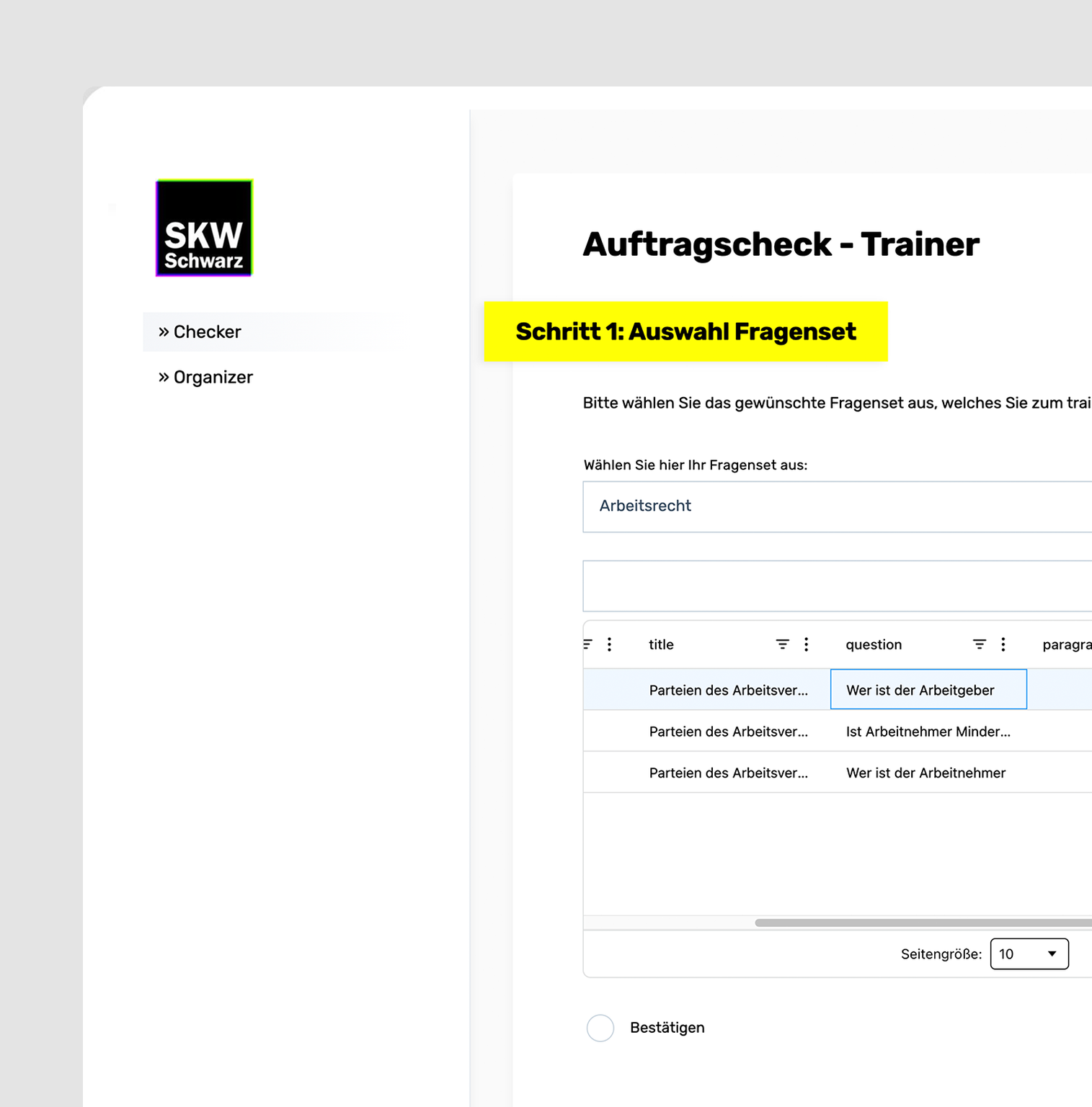
UNOY Legal Engine is the product suite for controlled legal workflows. At SKW Schwarz in the Co-Build model with two parallel workflows: contract review with attorney approval and cease-and-desist defence as a high-volume matter pipeline.
In use
- Contract review with attorney approval
- Cease-and-desist defence workflow
- Client records system integration
- Vendor continuity documented
- EU data residency + ISO/IEC 42001
Model & key data
- Co-Build · large German law firm
- Two parallel workflows
- Client records system integration
Who is SKW Schwarz?
SKW Schwarz Attorneys at Law
SKW Schwarz is one of Germany's leading commercial law firms with offices in Munich, Frankfurt, Dusseldorf, Hamburg and Berlin. 120+ lawyers advise on IT law, data protection, compliance, M&A and litigation. Client base: DAX corporations, international companies, tech mid-market.
Engagement letters are the entry document for every matter. Hundreds per month must be reviewed against internal playbooks: language, clauses, liability provisions. What the firm has learned from decades of experience is embedded in those playbooks. Until now, every new contract had to be reviewed manually.
The Challenge
What was difficult before.
With 120+ lawyers and hundreds of contracts per month, manual review is a bottleneck. Each attorney reads every engagement letter against the internal playbook, marks deviations, drafts redlines. Hours per contract, hundreds of contracts per month, hundreds of attorney-hours per month, just for a preliminary review.
The alternative would have been running a chatbot over the contracts. SKW Schwarz did not want that. Chatbots do not deliver a traceable review. They give a sense of correctness without allowing every decision to be traced back to the playbook rule.
What the firm needed instead: a workflow that works through the playbook question by question. Each clause is checked against the corresponding playbook rule. Result: a redline with a reference per clause, algorithmically exact, fully traceable.
Application
Reviewing engagement letters question by question.
The engagement letter is uploaded by the client or external counsel. UNOY OS processes it against the internal playbook. Within minutes, with a ready-to-sign redline.
Step
Upload the contract.
Step 01
PDF or Word document, drag & drop or API. The system classifies: engagement letter, NDA, consulting agreement, license agreement. Separate playbooks per contract type.
Step
Extract clauses.
Step 02
UNOY OS breaks the contract into individual clauses. Each clause is mapped to a playbook category: liability, confidentiality, termination, jurisdiction, etc.
Step
Playbook review question by question.
Step 03
For each clause: what does the SKW playbook say? What is the target wording? Where does the actual clause deviate? What risks arise? Every question is answered algorithmically, with a source reference into the playbook.
Routing logic
Clause in playbook: Redline with target wording · Edge case (clause new, practice unclear): Escalation to senior attorney with rationale · No match: Note "manual review required" in the redline.
Step
Generate redline.
Step 04
A redline proposal is generated from the deviations. Each change with rationale and playbook reference. The attorney sees: what is changed, why, against which internal rule.
Step
Attorney approves.
Step 05
The responsible attorney reviews the redline, accepts or modifies. Not the system signs, but the attorney. But they do not start from zero; they start from a structured proposal that has been checked against the playbook.
Application
Complex cease-and-desist letters in 3 minutes, with attorney oversight.
Trademark cease-and-desist letters are not standard correspondence; every infringement is different. UNOY orchestrates skills, templates and cost calculation in the background. The attorney directs, approves and takes responsibility.
Step
Capture client intake in a structured way.
Step 01
Email from the client with trademark infringement details, documents, screenshots, evidence. The attorney starts COIA, submits the documents as attachments, selects the appropriate playbook (UWG, trademark law, contractual penalty, etc.). Skills extract the relevant information.
Step
Skills orchestrate the letter.
Step 02
UNOY OS works in the background: matching template to the type of infringement, drafting the cease-and-desist declaration tailored to the specific violation, calculating costs per the fee schedule, identifying and correctly assigning attachments. For specialised constellations, agents with deeper domain expertise take over.
Routing Logic
Standard UWG case: Skills build the letter · Special case (e.g. unusual infringement form): Agent with specialist depth takes over · Unclear evidentiary basis: Stop with query back to the attorney.
Step
Attorney reviews, signs and sends.
Step 03
Completed cease-and-desist letter with declaration, correct cost calculation, full attachments. The responsible attorney reviews, accepts or modifies. Only after their approval does the letter leave the firm. Professional indemnity is carried by SKW Schwarz, not the system.
How this works
Natural-language input, workflows in the background.
The attorney gives instructions in natural language, just as they would to a colleague. COIA orchestrates the defined workflows in the background: template selection, cost calculation, attachment structure. The skills define the rules; the agents handle specialised tasks.
The result is not "a chatbot response". It is a structured, rule-governed letter with a source reference per clause: prepared by UNOY, approved by the attorney.
Learnings
What we learned.
SKW Schwarz was the first large-firm client to use UNOY in production: first for contract review, then for cease-and-desist matters. What we learned from both applications:
Attorneys do not want a chatbot. They want an infrastructure where their own playbook lives and every review works through it traceably. For contract review that runs deterministically: clause by clause, with source references. For cease-and-desist matters UNOY orchestrates in the background: skills select templates, calculate costs, assign attachments. Both times: the attorney signs, not the machine.
Skills are the key to quality assurance. The real intelligence lies not in the AI but in the skills: the work instructions that define how UNOY handles a given matter. Whoever maintains the skills controls the quality. The attorney does not draft every letter personally; they maintain the rules by which letters are produced.
The ROI is not "the attorney works less". It is "the attorney works where their judgment matters." Routine runs in a structured way; the attorney's word comes where it is needed.
Frequently Asked Questions
What you want to know.
Does UNOY replace the attorney in contract review?
No. UNOY OS prepares the review against the internal playbook, algorithmically exact and traceable. Legal responsibility rests with the responsible SKW Schwarz attorney who approves the redline.
How secure is the playbook on the UNOY infrastructure?
The playbook remains under SKW Schwarz responsibility, isolated per client, in data centres certified to ISO 27001, SOC 2 Type II and ISO/IEC 42001 (AI Management). EU data residency, no third countries. Attorney-client privilege applies because SKW Schwarz itself is a licensed firm.
What does an engagement letter review cost?
SKW Schwarz uses the Co-Build model: one-time setup for the playbook workflow, then a fixed price per review. Discuss specific terms directly with Alexander Skribe.
Can the system review other contract types?
Yes. SKW Schwarz set up the workflow for engagement letters; additional contract types (NDA, consulting agreement, license) follow the same pattern: their own playbook, their own review rules, the same technical workflow.
Who is liable if the redline contains an error?
The approving attorney at SKW Schwarz. The system makes the proposal; the attorney accepts or modifies it. Legal responsibility remains with the firm, with full professional indemnity.
What happens if UNOY ceases operations?
At contract end, SKW Schwarz receives all playbooks, workflows, skills and audit logs as an export. The playbook rules are documented as JSON logic. Workflows can continue running on their own infrastructure or be ported to another provider. No lock-in arises: the legal logic belongs to SKW Schwarz, not UNOY.
§ 07 · Tech Stack
What runs under the hood.
Multi-contract-type engine
Engagement letter, NDA, consulting agreement, license agreement, each type with its own playbook
Clause extraction
PDF/Word broken into semantic clauses, with position and context
Playbook rule engine
SKW Schwarz playbook as an executable rule set, directly editable by attorneys
Redline generator
Track-changes format in Word, with rationale and playbook reference per change
ISO 27001 + SOC 2 Type II + ISO/IEC 42001
Attorney-client privilege compatible, isolated per client
Audit trail
Every review step documented, exportable for audits
Integration with existing systems
Microsoft Word · Outlook · iManage / NetDocuments · DocuSign · internal playbook library · audit storage. Triggerable from the firm DMS or via API.
Data residency & GDPR
EU data centres in Frankfurt and Vienna · Data processing agreement (DPA) available on request · Sub-processor list documented · Client data stored encrypted and attorney-privilege compliant.
AI governance per ISO/IEC 42001
UNOY OS implements an AI management system per ISO/IEC 42001. Matter inventory, risk assessment per workflow, approval stamp per matter, quarterly review trigger. AI governance runs as a process, not only as a policy.


Give us a real matter.
In 45 minutes we assess your matter, free of charge and without obligation. Self, Co-Build or Delivery, depending on what fits.